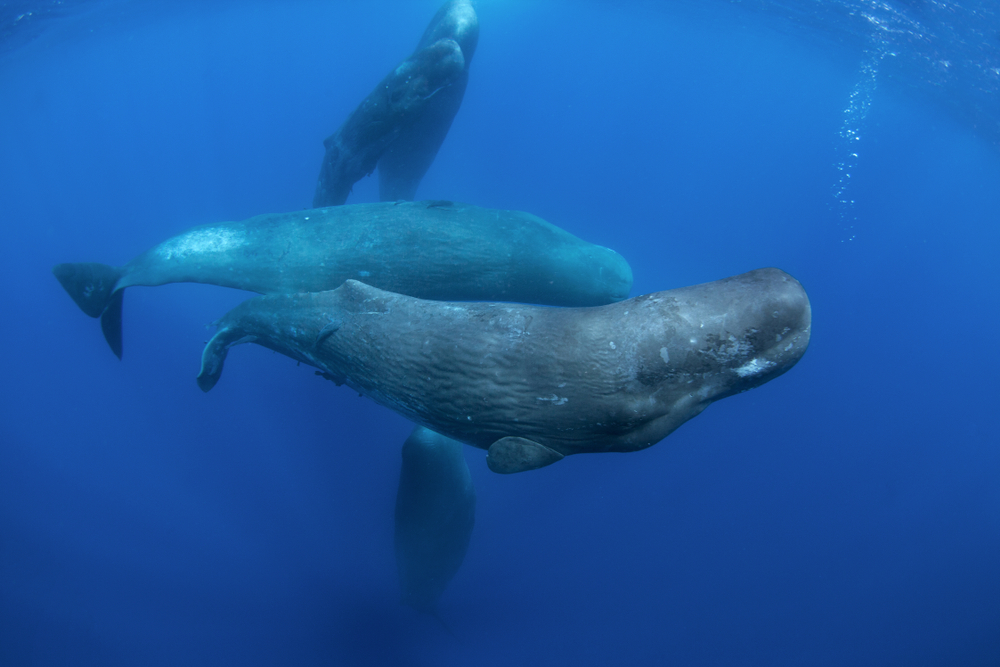
The Last Sperm Whales of the Eastern Mediterranean
Fewer than 200 sperm whales remain in the entire Eastern Mediterranean, most of them in the Hellenic Trench, a critical habitat for the whales. After spending nearly an hour diving in the depths, they surface for a brief but critical period to breathe and recover. For 10 to 15 minutes, they stay at the surface: exposed, and vulnerable. In one of the world’s busiest shipping corridors, this moment can be fatal as they are unable to react quickly to fast-moving vessels passing through its habitat.
The Hellenic Trench, formed by the convergence of the Eurasian and African plates in the Ionian and Libyan Sea, is the most important habitat for sperm whales in the eastern Mediterranean.
Sperm whales were first documented in the Hellenic Trench in 1998. Since then, scientists at the Pelagos Cetacean Research Institute have observed and photo-identified these animals over decades of fieldwork, coming to know 170 individuals, each one named and catalogued. Today, the entire Eastern Mediterranean population is estimated to number fewer than 200 individuals, most of them found in these waters.
When Dr. Alexandros Frantzis set out to research sperm whales in Greek waters in 1995, few people believed they were there at all. Then, in the autumn of 1998, while sailing south-west of Crete, his team lowered a hydrophone into the waters above the Hellenic Trench. On the second day, they detected the unmistakable clicks of sperm whales, just a few hundred metres from the Greek coast. That discovery marked the beginning of the research effort that would later evolve into SAvE Whales.
A life spent in the deep
Sperm whales are the largest toothed whales on Earth, reaching up to 20 metres in length and weighing up to 50 tonnes, and possess the largest brain of any animal. They are also among the ocean’s most remarkable divers. They descend to depths of 600 to 1,000 metres or more up to 20 times a day in search of deep-sea squid. Each dive lasts 45 to 60 minutes, during which the animals endure pressures of up to 100 times greater than at the surface, in complete darkness, using the air trapped in their nasal cavities to produce the clicking sounds that help them locate their prey. After each dive, exhausted, spending several minutes resting and replenishing their oxygen stores before descending once more into the deep.
A population under severe pressure
Sperm whales reproduce extremely slowly. Females give birth to a single calf only every four to six years, meaning that every individual lost is a significant blow to the population’s survival. The International Union for Conservation of Nature (IUCN) classifies the Mediterranean sperm whale already as endangered. It is also listed as a priority species by ACCOBAMS, the Agreement on the Conservation of Cetaceans of the Black Sea, Mediterranean Sea and contiguous Atlantic area, reflecting the urgent need for conservation action. With fewer than 200 individuals remaining in the Eastern Mediterranean, this isolated population is perilously close to a point from which recovery may no longer be possible.
Since 1997, around 40 sperm whales have stranded in Greek coast. Nearly 60 per cent of them showed serious injuries consistent with ship strikes. The number of unrecorded victims is likely considerably higher: sperm whales killed or injured at sea often sink to the seafloor before they can be documented, leaving many casualties unrecorded.
In 2017, OceanCare and the Pelagos Cetacean Research Institute achieved recognition of the Trench as an Important Marine Mammal Area (IMMA) by the IUCN; a global designation that reflects the area’s critical importance for sperm whales and Cuvier’s beaked whales. In 2024, Greece announced the establishment of a large-scale marine protected area, the Ionian National Marine Park. In 2025, PCRI, OceanCare, and The Green Tank submitted a detailed proposal for the design of the protected area, particularly with regard to shipping. The final conservation management plan is due to be finalised in 2026. Their protection is also enshrined in law: sperm whales are listed as a strictly protected species under the EU Habitats Directive and the Bern Convention, and as an endangered migratory species under the Bonn Convention.
ACCOBAMS has also identified the Hellenic Trench as one of five high-risk areas for ship strikes involving sperm whales worldwide.
Yet recognition alone will not save these whales. Without effective measures to reduce ship strikes and other human-induced threats, the sperm whales of the Hellenic Trench face a real risk of extinction within the coming decades. This is exactly what SAvE Whales is working to prevent.